A BRIEF HISTORY OF THE PHOENIX SINGERS
For a full account of the choir’s history, please see The Phoenix Singers – Past, Present & Future, which was published on the occasion of the choir’s 50th anniversary in 2016.
The Phoenix Singers of Shrewsbury was founded in 1965 by a small group of singers who had belonged to a disbanded choir, the St Mary’s Singers. The new choir’s first performance, of Schütz’s Christmas Story, was on 12 December 1965 at the Church of the Holy Spirit, Shrewsbury, under the leadership of Laurence Caller, who was also the vicar of the church.
During the following two years, Laurence conducted what was by then named The Phoenix Singers in more than six concerts in local schools or churches. The music for these early concerts included Byrd’s Mass for Four Voices, Britten’s Five Flower Songs (which soon became a feature of the choir’s repertoire), and two psalm settings by Kodaly, alongside a selection of madrigals and other shorter works.
In 1967, John Stephens, Music Advisor for Shropshire, became conductor. His first concert was given in St Chad’s Church, which was to become a regular venue in the years ahead. The programme for this concert included more Byrd and Kodaly, plus some very challenging carol settings by Richard Rodney Bennett – a sure sign that the choir was more than capable of tackling some difficult unaccompanied repertoire. The choir performed no fewer than eight times during 1967, with concerts featuring Haydn’s Nelson Mass (with organ accompaniment), Handel Zadok the Priest, and more Britten, including the Hymn to St Cecilia.
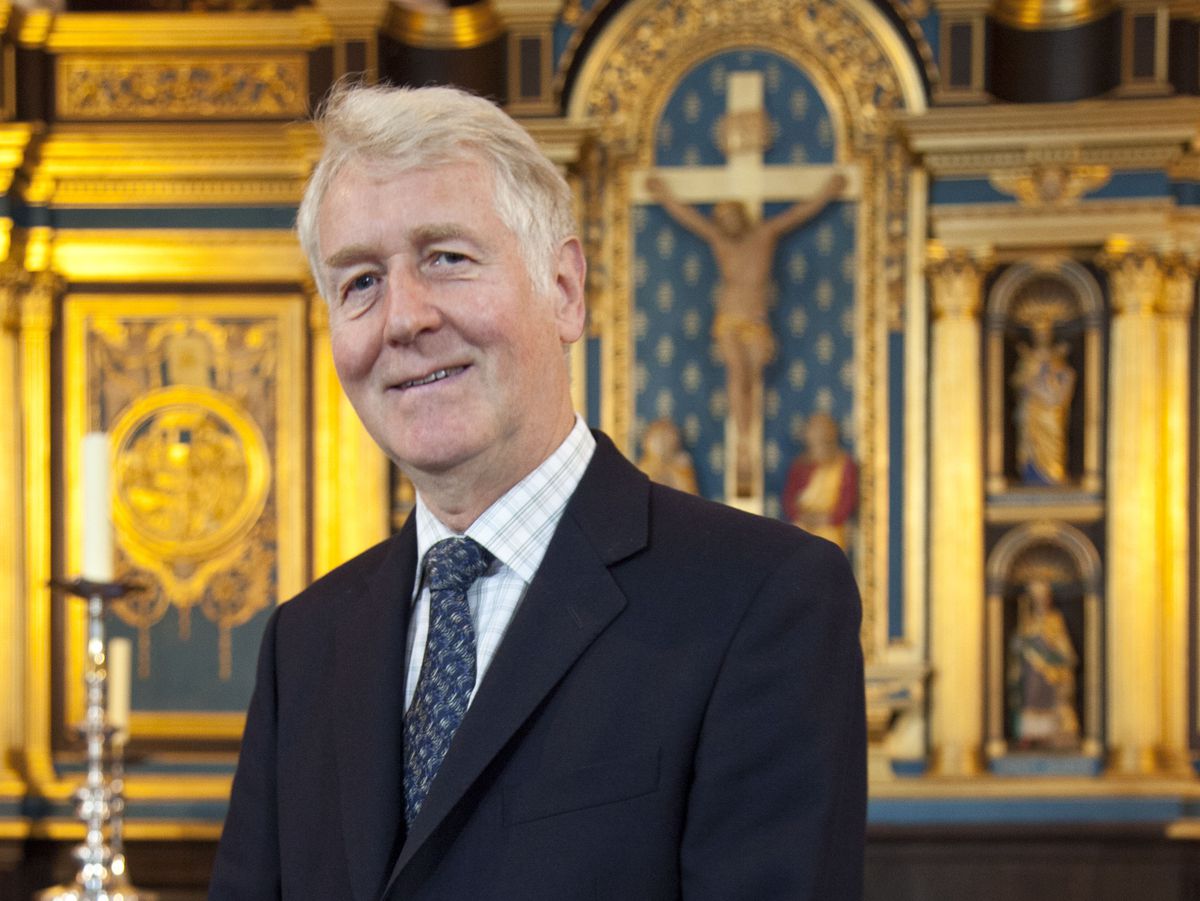
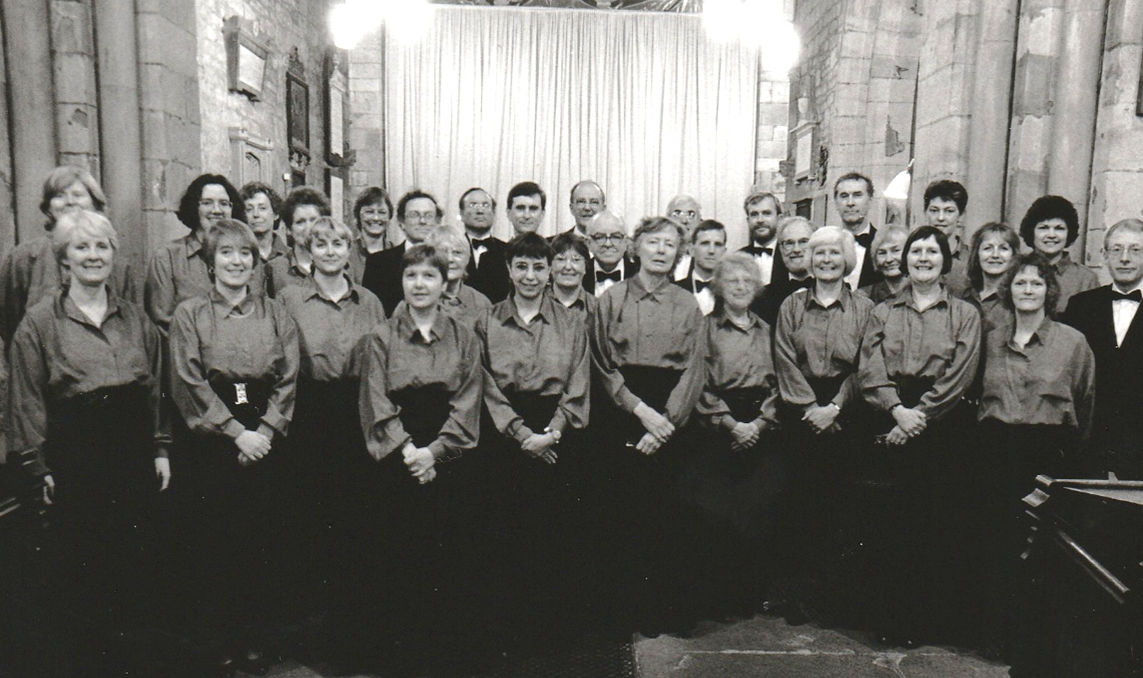 When John Stephens left Shropshire for Hampshire in 1969, his successor at County Hall, and also with The Phoenix Singers, was Richard White, who was to remain conductor of the choir for the next 40 years. His brought enormous energy, experience and dedication to the role, often combining with other local choirs, instrumental groups, and schools. Summer concerts of madrigals, folksongs and partsongs, and popular Christmas concerts featuring music from all over the world (and sometimes music by Richard himself), were contrasted with more challenging repertoire, especially by Britten and Bach, but also composers as varied as Monteverdi, Victoria, Bruckner, Respighi, Vaughan Williams, and Bernstein, as well as contemporary commissions.
 The choir’s first performance with a full orchestra was in 1972, with Bach’s St John Passion, a work the choir has performed no fewer than six times over the last six decades, most recently to celebrate its 60th anniversary in 2026. Other highlights of the Richard White years included three performances of Tallis’s 40-part motet Spem in alium; a re-staging of Purcell’s semi-opera The Fairy Queen; polychoral motets by the two Gabrielis; and music by Latin-American composers. In collaboration with other choirs or orchestras, larger repertoire was also tackled, including Orff’s Carmina Burana and Walton’s Belshazzar’s Feast. Excluding those, Richard conducted nearly 170 concerts with the choir, performing nearly 600 works.
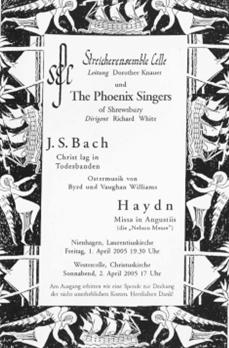
Another major feature of Richard’s tenure were several overseas tours and exchanges. Between 1969 and 2009 there were twelve tours with thirteen return visits, including Russia, Holland, Estonia, France, Italy, Poland, and especially and most frequently to Germany as a result of a long-term relationship with the Celler Streicherensemble.
After Richard’s retirement, the baton passed to John Naylor, who between 2009 and 2011 directed six concerts, including Bach’s St Matthew Passion and Monteverdi’s Vespers of 1610. He in turn was succeeded by Richard Walker, former Director of Music at Harrow School, who maintained the choir’s high standards and continued to expand the repertoire: masses by Langlais, Duruflé and Flor Peeters sat alongside the traditional fare, with several Haydn Masses and a Messiah in 2016 (oddly, only the third time the choir had performed it). Another joint concert with the Celler Streicherensemble in 2017 included both Mozart’s Requiem and Handel’s Dixit Dominus. Contemporary composers also featured, encouraged by two composers’ competitions, won respectively by Kristen Halstead and Owain Park. Another highlight was a performance in 2019 of the Requiem by Carl Rütti, a video of which reached the composer, who wrote back:
 “What an outstanding performance: great soloists, brilliant organist, a wonderful choir conducted so carefully by a highly committed and sovereign conductor.”
Richard also continued to nurture the Phoenix Orchestra, a group of local freelance players, who were a feature of most of the concerts requiring instrumental accompaniment.
The Covid lockdowns of 2020-21 resulted in several cancelled concerts, but the choir bounced back quickly when restrictions were lifted, with a concert in November 2021 entitled (appropriately) “I was glad”, which included the second performance of the Rütti Requiem.
Richard Walker bowed out at the end of 2022, and Harrow was succeeded by Winchester on the appointment of David Thomas, former Director of Music of the latter. David’s four years with the choir were characterised by thematic programming, such as a concert in 2024 of musical settings of the ‘Song of Songs’, a complete concert of music by Henry Purcell, and a greater emphasis on unaccompanied singing. Music ranged from Clemens non Papa to contemporary composers such as David Bednall, Will Todd, Eleanor Daley and Kerensa Briggs. In June 2025, the choir was invited to join with the English Haydn Orchestra under Steven Devine to perform Haydn's The Creation at the English Haydn Festival in Bridgnorth. The choir also established a partnership with a professional period instrument ensemble, Noxwode Baroque, which culminated in a performance of Bach’s St John Passion in 2026 to mark the choir’s 60th anniversary.
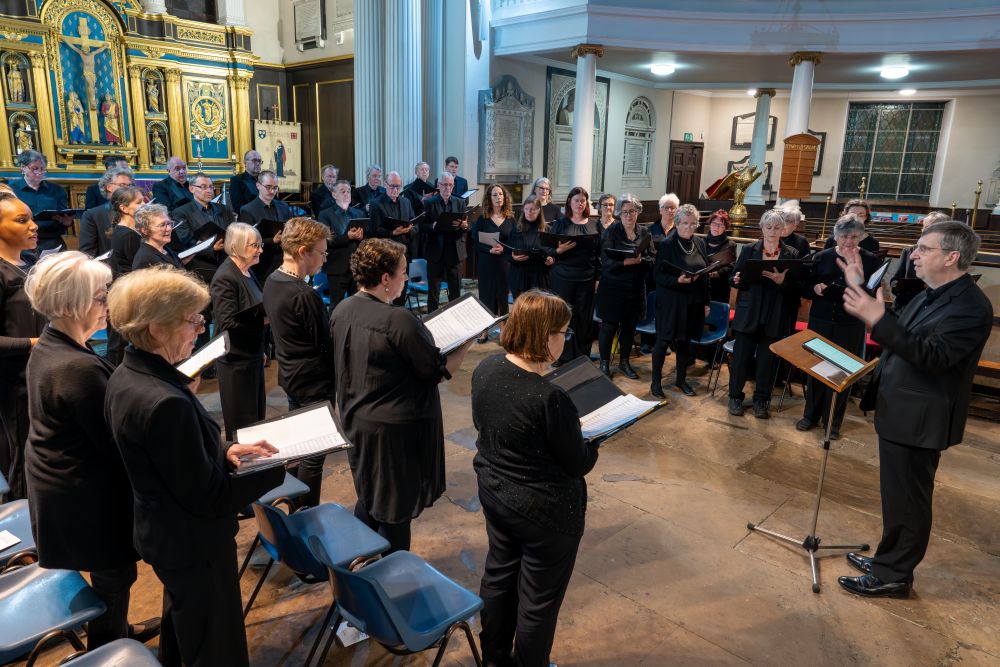 Our new Musical Director, Sierra Farquhar-Wulff, took up her appointment after Easter 2026 and hosted a come and sing event in June.